# How to Compost at Home: What Happens Inside the Pile and the Three Levers You Control
A compost pile is a microbial habitat: greens and browns set the carbon-to-nitrogen balance, water and air compete for the same pore space, and pile size decides whether heat stays — which is why every smell, stall and fruit fly points at one specific lever.
> composting · soil amendment · carbon nitrogen ratio · garden waste · About 7 min · Nov 14
## Key points
1. Composting is managing a microbial habitat; the materials are food, and the microbes are already present, so no starter is needed.
2. Carbon supplies energy and nitrogen supplies the protein microbes need to grow, which makes "greens" and "browns" a ratio rather than a color; two to three parts browns to one part greens by volume lands near the 30:1 target.
3. Heat is a byproduct of fast aerobic work, not the goal — but sustained 131°F or above for several days reduces pathogens, above roughly 140°F kills most weed seeds, and above about 160°F kills the decomposers.
4. Moisture and air compete for the same pore space, so an overwatered pile stops being aerobic and smells of rotten eggs or vinegar instead of merely working slowly.
5. A pile needs roughly 3×3×3 feet to insulate its own core; smaller piles lose heat as fast as they make it, and a pile much past a 5-foot cube can't be aerated or turned.
6. A hot batch turned weekly finishes in about two to four months, while a never-turned, continuously fed pile takes six months to a year or more and won't reliably kill seeds.
7. Finished compost is identified by behavior: it no longer reheats when turned, smells earthy, and is crumbly and uniform; unfinished compost reheats, smells sharp, and can tie up nitrogen or burn roots.
8. Each common failure maps to one lever: ammonia means too much nitrogen, rotten smells mean no oxygen, a wet sweet pile that won't heat means too little nitrogen, a center-only warm spot means the pile is too small, and flies or digging animals mean exposed scraps.
9. Persistent broadleaf herbicides such as clopyralid and aminopyralid survive composting, so hay, manure and turf clippings of unknown origin can contaminate compost destined for vegetables.
---
Composting looks like a recipe problem — layer this, turn on Sundays — when it is really a habitat problem. The materials you pile up are food, and the microbes that eat them are already there, in soil, leaves and food scraps. You don't buy a starter; you keep conditions good enough that they eat fast [1].
That reframes the confusing parts. A pile has four inputs — carbon, nitrogen, water, air — and the first two are what everyone calls "greens and browns." Those inputs feed one reaction, and the reaction's most visible output is heat. Heat is not the goal; it is evidence. But heat does one thing that matters: a pile warm enough for long enough also kills many weed seeds and pathogens, which is what separates compost from rotten stuff.
So the chain runs like this: **food balance, water and air set how fast microbes work; how fast they work sets the temperature; the pile's size decides whether that heat stays; when the food runs out, the pile cools and cures.** Every common compost problem is a break somewhere in that chain, and every fix is one of three levers.
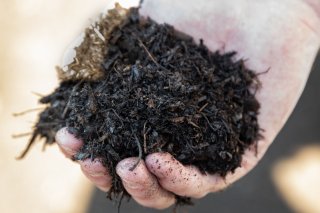
## Why a compost pile heats up: carbon is fuel, nitrogen is the crew
Microbes use carbon-rich material for energy. They break carbon compounds apart, and that oxidation releases heat, the same way any fuel-burning does at small scale. Nitrogen-rich material supplies the protein and enzymes they need to grow and multiply — the workers, not the fuel [2].
Hence the two words beginners hear constantly:
- **Browns** are dry, coarse or woody: fallen leaves, straw, shredded paper and cardboard, twigs, wood chips. High carbon relative to nitrogen.
- **Greens** are fresh and wet: vegetable and fruit scraps, coffee grounds, grass clippings, green trimmings. High nitrogen.
The label describes a *ratio*, not a color. A banana peel is a "green"; dry November leaves are "browns." Everything organic contains both elements — the only question is which one is scarcer.
The target is roughly 30:1 carbon to nitrogen to start, and anything from about 25:1 to 40:1 works [2][4]. You don't weigh anything: by volume, two to three parts browns to one part greens lands in that range, because browns are bulky and greens are dense [1].
| Material | Rough C:N | Acts as |
| --- | --- | --- |
| Sawdust | ~500:1 | extreme brown |
| Dry leaves | ~60:1 | brown |
| Grass clippings | ~20:1 | green |
| Kitchen scraps | ~15:1 | green |
Both failure modes follow from the ratio. **Too much carbon** and microbes run short of the nitrogen they need to build working cells: decomposition crawls, the pile stays cool, and half-done material spread on a bed can temporarily tie up soil nitrogen as it finishes. **Too much nitrogen** and the surplus escapes as ammonia — that sharp smell is nitrogen leaving. Both are fixed by adding the other side, not by waiting.
## Moisture and air are two ends of one lever
Microbes take up dissolved material, so a pile needs water: about 40–60% moisture, which in practice means a wrung-out sponge. Squeeze a handful and one or two drops should appear [3]. Most home piles are too dry rather than too wet.
But water and air compete for the same space. Oxygen reaches the middle of a pile through gaps between particles, and water fills those gaps. So overwatering doesn't give you a wetter aerobic pile — it gives you an anaerobic one, where different microbes work slowly and produce the rotten-egg, vinegar or rancid-butter smells that make neighbors complain [3]. Compaction and a mush of fine wet material do the same thing.
That's why bulky browns earn their keep twice: twigs and chips at the base, coarse material throughout, keep pore space open. And it's why turning isn't a ritual — it pushes fresh air in and moves the cool, less-processed outer layer into the hot center.
## Why a pile has to be a few feet across
Heat leaves through the surface; microbes generate it throughout the volume. Make the pile small and the surface-to-volume ratio is bad, so heat escapes about as fast as it's produced and the pile never warms.
The working minimum is a cube 3 feet on a side — 27 cubic feet, roughly one cubic yard. That's the size at which the outer layers insulate the core and the core gets hot [3][5]. Past about a 5-foot cube the opposite problem appears: air can't reach the middle and the pile is hard to turn. In between, expect the center to be much hotter than the edges, which is why "warm in the middle and nowhere else" is the classic sign of an undersized pile.
A bin doesn't change any of this. It keeps things tidy, keeps animals out and holds moisture; it isn't what makes a pile hot. A 3-foot bin filled to the top is a 3-foot pile; half full it is a small one.
Because heat speeds the microbes up, which makes more heat, a well-built pile can climb to 130–160°F within days and stay there for weeks if turned weekly [3]. That band has consequences: sustained 131°F or above for several days is what reduces human pathogens, above roughly 140°F kills most weed seeds, and above about 160°F starts killing the decomposers, stalling the pile.
One practical consequence: heaping fresh scraps onto a hot pile resets it. Gardeners who want fast compost build a batch to full size, let it run, and start a second pile for new material.
## How long it takes, and how to tell finished compost from unfinished
A hot batch turned about weekly heats within days, stays hot for several weeks, shrinks by roughly half in about a month, then cures for four to eight weeks as it cools [3]. Call it two to four months, weather permitting. A pile you never turn and keep adding to can take six months to a year or more — a different method with a different result, and it won't reliably get hot enough to kill seeds.
Judge finished compost by behavior, not the calendar:
- **It no longer reheats when you turn it.** This is the most reliable test.
- It smells earthy, not sour or like ammonia.
- It's dark, crumbly and roughly uniform; you can't identify what went in, apart from stubborn eggshell or twig bits, which you can screen out and toss into a new pile.
Unfinished compost still heats when turned, still smells sharp, and still shows you what it used to be. It isn't poison, but it keeps decomposing where you put it, can burn seedlings with ammonia, and can compete with plants for nitrogen. When in doubt, give it another month.
## What each common problem is telling you
The pile is a fairly honest instrument. Read the symptom back to a lever:
| What you see or smell | Broken link | Fix |
| --- | --- | --- |
| Sharp ammonia smell | Too much nitrogen | Mix in browns: leaves, shredded paper, chips |
| Rotten egg, vinegar, rancid smell | No oxygen — too wet or compacted | Turn it, add coarse dry material, cover against rain |
| Wet and sweet-smelling but never heats | Too little nitrogen | Mix in grass clippings, fresh scraps, manure |
| Warm only in the center | Pile too small | Build up to 3×3×3, or insulate the sides |
| Dry all through, nothing happening | Too little water | Water while turning; cover to hold moisture |
| Clouds of fruit flies, or animals digging | Food scraps exposed | Bury scraps 8–12 inches deep, top with browns |
| Hot, then cold, then hot after turning | Normal batch cycle | Turn to re-aerate; start a new pile for new scraps |
"Nothing is happening," then, has four different causes — too small, too dry, too little nitrogen, too little air — and the diagnostic is a squeeze plus a look at the center.
## What not to add, and one contaminant that doesn't compost
Skip meat, fish, dairy, fats and oily food in a backyard pile: not because they're forbidden, but because they smell, attract animals, and need more reliable heat than a home pile delivers. Skip pet waste, diseased plants, and weeds that have already set seed unless your pile truly runs hot. Coffee grounds, eggshells, tea bags and citrus are all fine.
One caveat before you accept free inputs: a group of broadleaf herbicides — clopyralid, aminopyralid, picloram — passes through livestock, survives composting, and stays active in soil for a year or longer [6]. Compost made from hay, manure or turf clippings of unknown origin can carry it into a vegetable bed, where it shows up as twisted, cupped new leaves on tomatoes, peas or beans. Composting does not destroy it; ask where hay and manure came from, or test a batch with pea seedlings before spreading it wide.
Compost is how a bed's soil gets refilled each season, and the three levers give you something more useful than a recipe: a way to look at a pile that isn't working and know which one to move.
## Mind map
```mermaid
flowchart LR
A["A compost pile is a microbial habitat"] --> B["Four inputs: carbon, nitrogen, water, air"]
B --> C["Browns = energy Greens = protein and growth"]
B --> D["Water and air share the same pore space"]
C --> E["Microbes work faster"]
D --> E
E --> F["Heat is the exhaust 131-160 F"]
F --> G["Heat speeds microbes up positive feedback"]
G --> E
H["Pile size 3x3x3 ft insulates the core"] --> F
F --> I["Food runs out, pile cools"]
I --> J["Curing 4-8 weeks"]
J --> K["Finished compost: no reheat, earthy, crumbly"]
M["Symptoms: smell, no heat, flies, dryness"] --> N["Read back to one lever"]
N --> C
N --> D
N --> H
```
## Glossary
- Browns and greens:dry woody or dead material versus fresh wet material — shorthand for which side of the carbon-to-nitrogen balance a material supplies.
- Carbon-to-nitrogen ratio (C:N): how much carbon a material carries per unit of nitrogen; near 30:1 keeps microbes supplied with both fuel and building material, and too far either way stalls the pile.
- Aerobic decomposition:breakdown that uses oxygen, producing heat and little odor, unlike the slow smelly version that takes over once water fills the pore spaces.
- Self-insulation:the reason a pile needs a minimum size — outer layers trap the heat the core produces, while a small pile loses it as fast as it makes it.
- Curing:the cooler final stage after the hot phase, when the pile stabilizes enough to be safe around roots.
- Nitrogen tie-up:what carbon-heavy, unfinished material does in soil — microbes borrow nitrogen from the surrounding soil to keep digesting it, temporarily starving plants.
## Sources
1. [US EPA, Composting At Home — greens and browns, two to three parts browns by volume, moisture and burying food scraps](https://www.epa.gov/recycle/composting-home)
2. [US EPA, Approaches to Composting — what microbes use carbon and nitrogen for, ~30:1 ratio, 131–160°F range](https://www.epa.gov/sustainable-management-food/approaches-composting)
3. [NC State Extension Gardener Handbook, Composting — pile size, 40–60% moisture, temperature thresholds, curing time, troubleshooting table](https://content.ces.ncsu.edu/extension-gardener-handbook/2-composting)
4. [University of Maine Cooperative Extension, Home Composting — C:N ratios of common materials, 27–125 cubic foot size limits](https://extension.umaine.edu/publications/wp-content/uploads/sites/52/2022/11/1143.pdf)
5. [University of Nevada Extension, Composting Yard and Vegetable Wastes — pile size, turning, curing signs, symptom table](https://extension.unr.edu/publication.aspx?PubID=3521)
6. [OSU Extension, Herbicide-contaminated compost and soil mix — clopyralid and aminopyralid persist through composting](https://extension.oregonstate.edu/catalog/em-9307-herbicide-contaminated-compost-soil-mix-what-you-should-know-what-you-can-do-about)
---
Original article: https://eulore.ai/articles/how-to-compost-7b526d8a
> **Eulore** · Start small. Go deep.
>
> Eulore is an AI learning tool built around connected articles, each a 5–10 minute read. Ask questions as you go and help shape what comes next. That’s how this article was created.
>
> Start your own series → https://eulore.ai